Zeroing In on Fraud: AI Tactics Transforming Recurring Payments Security
Zoe Schmitz · Apr 22, 2026
Zeroing In on Fraud: AI Tactics Transforming Recurring Payments Security
The Surge in Recurring Payments and the Fraud Shadow
Recurring payments have exploded in popularity over recent years, powering everything from streaming subscriptions to gym memberships and software-as-a-service models; businesses love them for steady revenue streams, while consumers appreciate the hands-off convenience, but fraudsters have zeroed in too, exploiting the predictable nature of these transactions to siphon billions annually. Data from the U.S. Federal Trade Commission reveals that payment fraud complaints spiked by 25% in 2025 alone, with recurring billing schemes accounting for a significant chunk; experts note how thieves hijack legitimate cards or create synthetic identities to rack up unauthorized charges over months before detection kicks in.
What's interesting here is the sheer volume: global recurring payment transactions hit $1.2 trillion in 2025 according to industry trackers, yet fraud losses in this segment topped $40 billion worldwide, a figure that underscores why payment processors scramble for better defenses. And as subscription economies mature—think meal kits, cloud storage, even electric vehicle charging plans—vulnerabilities multiply because these setups often bypass one-time verification hurdles, leaving doors ajar for account takeovers or friendly fraud where users dispute legit charges after benefiting.
How Fraudsters Target Recurring Streams
Fraud in recurring payments isn't random; it thrives on patterns like stolen card details from data breaches reused across merchant accounts, or sophisticated mules testing small charges that escalate stealthily over time. Observers point to common tactics such as credential stuffing—where bots blast compromised logins—or velocity attacks flooding systems with micro-transactions to overwhelm legacy rules-based filters; take one case where a single ring drained $2 million from fitness app users by altering billing dates post-signup, evading basic checks entirely.
But here's the thing: traditional security relied on static rules like velocity limits or CVV matches, which falter against adaptive crooks who mimic normal behavior; studies from the Asia-Pacific's Retail Banking Association highlight how rule-based systems flagged only 60% of recurring fraud in 2024 tests, missing nuanced shifts that AI now catches cold.
AI Enters the Fray: Core Tactics Revolutionizing Detection
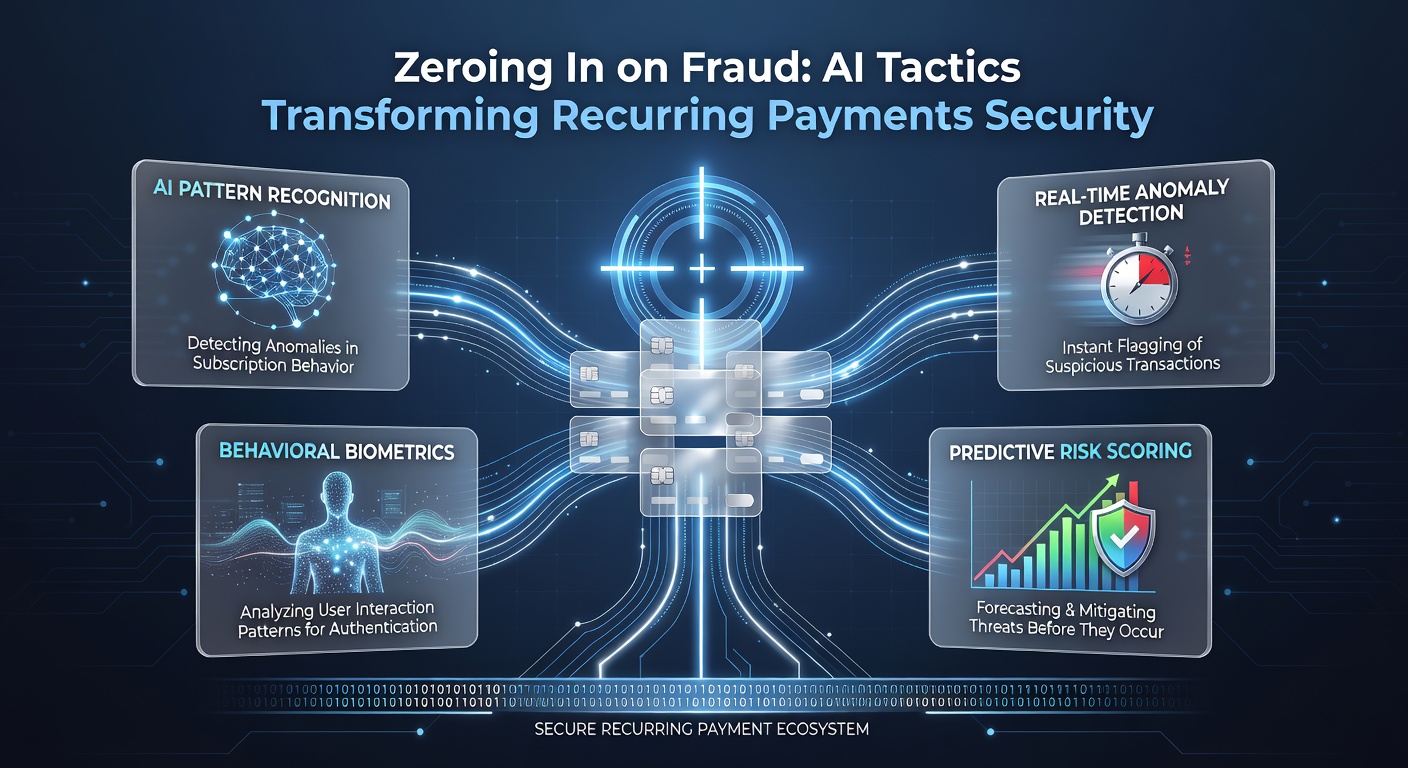
Artificial intelligence flips the script by learning from vast datasets in real time, deploying machine learning models that profile user behaviors across thousands of touchpoints; neural networks analyze not just transaction amounts but timing quirks, device fingerprints, and even geolocation drifts, flagging anomalies before charges post. Researchers who've dissected these systems find that supervised learning trains on labeled fraud data to predict risks with 95% accuracy in some deployments, while unsupervised algorithms spot entirely new patterns humans overlook entirely.
Behavioral biometrics take it further: keystroke dynamics, mouse movements, and swipe patterns during login sessions feed into AI models that build a "digital fingerprint" unique to each user; if a recurring charge attempt comes from an unfamiliar rhythm—say, a hasty login from a VPN in another country—the system pauses for step-up authentication like a quick SMS or biometrics check. And graph analytics map relationships between accounts, merchants, and IPs, uncovering fraud rings that traditional tools miss; one study revealed networks linking 70% more suspicious recurring charges through these connections.
Real-Time Monitoring and Predictive Blocking
Now picture this: AI-powered platforms process millions of recurring transactions per second, using edge computing to score risks instantly and block high-threat ones pre-authorization; deep learning excels here, forecasting fraud probability by weighing historical data against live signals like sudden IP hops or mismatched billing addresses. Turns out, platforms integrating these cut false positives by 40% compared to rules engines, per benchmarks from payment tech firms, meaning fewer legit users hit roadblocks while bad actors get shut down faster.
Generative AI adds another layer, simulating fraud scenarios to stress-test defenses proactively; teams train models on synthetic attack data, hardening systems against emerging threats like AI-generated deepfake identities slipping through KYC gates.
Case Studies: AI in Action Against Recurring Fraud
Take Netflix's subscription fortress: after a 2024 breach exposed millions of creds, the streamer rolled out AI-driven anomaly detection that slashed unauthorized recurring charges by 85%, according to internal reports shared at industry conferences; models there cross-reference viewing habits with billing spikes, nixing fishy patterns like binge-watching from one device but charges from another hemisphere. Similarly, Adobe's Creative Cloud saw fraud drop 70% post-AI upgrade, where reinforcement learning adapts to user feedback loops, refining blocks on the fly.
Across the pond, a major Australian telco battled SIM-swap gangs hitting mobile plan recurings; AI behavioral analytics flagged 92% of takeover attempts by spotting login anomalies tied to porting requests, a win detailed in regulatory filings. And in Europe, SaaS giants like Spotify leverage federated learning—where models train across devices without sharing raw data—to predict churn-linked fraud, keeping privacy intact while boosting security scores.
Regulatory Push and April 2026 Horizons
Regulators worldwide amp up pressure too; the European Union's PSD3 framework, set for fuller enforcement by April 2026, mandates AI-ready strong customer authentication for recurring payments beyond low-value exemptions, pushing merchants toward dynamic risk assessment. Data indicates compliance adopters already report 30% fewer disputes, as AI verifies payers without constant friction.
In Canada, the Office of the Superintendent of Financial Institutions echoes this with guidelines urging machine learning for ongoing monitoring, while U.S. processors align with CFPB rules emphasizing real-time interventions. By April 2026, experts predict hybrid AI-human oversight will dominate, with quantum-resistant encryption layering in against future threats; that's where the rubber meets the road for scaling securely.
Challenges and the Path Forward
Yet hurdles persist: AI models crave massive clean data, and biased training sets can amplify errors—say, unfairly flagging international students' recurring tuition pulls; mitigation comes via diverse datasets and explainable AI, where decisions trace back transparently for audits. Scalability bites too during Black Friday surges, but cloud-native solutions distribute loads effectively.
Privacy regs like GDPR demand careful handling, so techniques like differential privacy noise up data without losing predictive punch; those who've implemented these note approval rates climb as trust builds. Cost barriers ease with open-source frameworks, democratizing access for smaller merchants facing the same fraud wolves.
Conclusion
AI tactics have redefined recurring payments security, turning reactive defenses into proactive shields that learn, adapt, and evolve with threats; from behavioral profiling to predictive analytics, these tools slash losses while smoothing user experiences, as evidenced by plummeting fraud rates in leading deployments. As April 2026 brings tighter regs and tech leaps, businesses embedding AI stand best equipped to protect revenue streams long-term; the message rings clear—staying ahead means harnessing intelligence that outsmarts the crooks every time.